

Desert Safari in Dubai — How to Choose Well and What Sets the Different Options Apart (Prices and Beyond)
Updated: Apr 8
Desert safari is the number one attraction in the Arabian Emirates. Almost everyone who comes to the Emirates wants to experience dune driving, watch the sunset over the desert and have dinner under the stars at a Bedouin camp whilst watching performances.
But when you start searching online, there are more options than you can possibly imagine!!! Hundreds of different camps offer safaris, prices vary enormously, and on the websites everything looks almost the same.
From my experience with tourists, many people feel a bit lost at this stage. That's why I'll try to put things in order and explain what's really worth knowing before booking a safari. I'll show you exactly what the differences are — because these differences determine whether you'll return from the desert with the most beautiful holiday memory, or with a sore back, sand in your sandwich and disappointment.
Types of desert — red sands vs yellow sands
The first thing worth knowing is that not every safari takes place on the same type of desert. In the area around Dubai, there are two main desert areas where desert safaris are organised, and the difference between them is very noticeable.

The first area is the red sands terrain. This is the better-known region, where the dunes are particularly high and the sand has a reddish hue. The landscape here is very impressive, which is why most of the better-known operators run their safaris in this area.
From what I see in practice, most tourists prefer safaris on the red sands. The landscape is more dramatic, and the dune driving feels much more like what people imagine when they think of a desert safari.

The second area is the yellow sands terrain. Here the sand is lighter and the dunes are relatively lower. Safaris in this region are usually slightly cheaper and the ride less intense.

The third area is in the Abu Dhabi region. The Abu Dhabi dunes offer spectacular desert landscapes — from the ancient Al Wathba Fossil Dunes to the mighty dunes of the Liwa oasis in the Rub al-Khali desert. The Al Wathba Fossil Dunes Protected Area encompasses over 1,700 fossilised dunes spanning an area of 7 square kilometres, making it one of the largest concentrations of such formations in a single location in the emirate.
Since most people choose the red sands, I'll focus primarily on those. Anyone who would also like information about safaris on the yellow sands is of course welcome to get in touch with me.
What does every safari typically include?
When you look at safari programmes online, you can sometimes get the impression that all companies offer exactly the same thing. To a large extent this is true, as the evening schedule is very similar in most camps.

Typically, a safari begins with a pick-up from the hotel and a drive to the desert. Upon reaching the dune area, the famous, thrill-filled dune bashing begins — for many people, this is the highlight of the entire safari.

After the dune bashing, there is usually a stop for sunset photographs in the desert, sandboarding, a short camel ride, and sometimes also the opportunity to have a photo taken with a falcon.
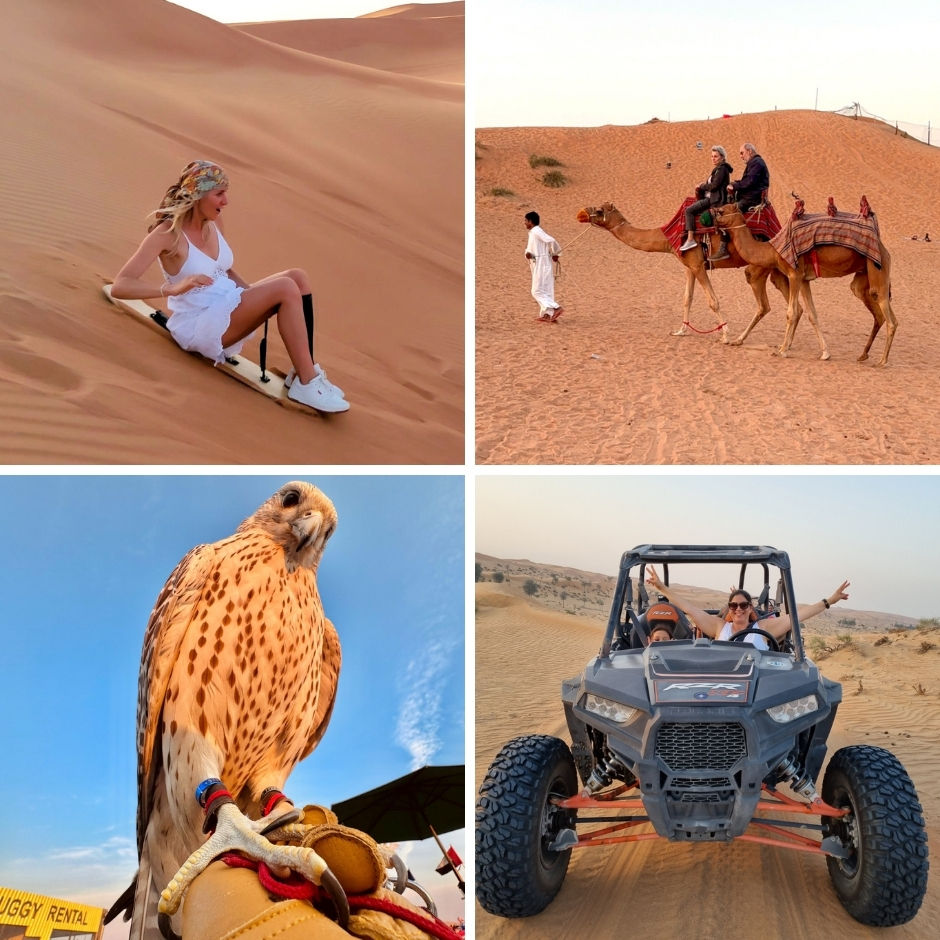
It is also in this area that you can take a quad bike ride — always for an additional charge (I'll explain more further on).
Then you arrive at the camp itself. There, an evening awaits that includes a barbecue-style dinner and buffet, a small henna tattoo for those who wish, and several traditional performances such as the tanoura dance, a fire show and belly dancing.
From my experience, many people are surprised to discover that the programme itself is very similar across different camps. That's why it's worth understanding that the real differences lie above all in the quality of the overall experience.

What truly sets one safari apart from another?
The biggest differences between individual camps don't come from the programme description, but above all from the small details that affect the entire experience.
The most important thing is always to pay attention to the quality of the camp and the food. There are very basic camps, but there are also more refined ones, with better food, more comfortable facilities and a more pleasant atmosphere.

Another factor that greatly affects the experience is the size of the camp. There are camps that can accommodate thousands of people in a single evening (it then looks rather like a production line). On the other hand, there are also smaller camps (up to 200 or even 100 guests), and the difference in atmosphere is enormous. From my experience with small groups, many people value smaller and quieter camps more — just imagine the queue for the buffet with 100 people, and then with 500.
The style of food is similar almost everywhere, but there can be differences in the quality and variety of food, depending on how much you pay.

It's also worth checking the type of 4x4 vehicles. On more expensive safaris, newer vehicles are usually used, which affects both comfort and the sense of safety.
Another matter I always recommend checking is licences and safety. It's important to make sure that the camp holds the appropriate licence and that the drivers and vehicles are authorised for off-road driving. Reputable camps are very careful about this and don't take unnecessary risks.
One more thing I sometimes observe is that with very cheap safaris, transport to the desert is by bus, but even when it comes to a shared vehicle, there can be long stops at buggy rental points on the way to the desert. The aim is to offer additional paid attractions, which is why you sometimes spend more time there than you might have expected.
Three categories of safari — the same name, three different worlds
Comparison: cheap vs. good vs. premium
All three write the same thing, and you see prices from 30 AED to 1,500 AED — for something that on paper looks identical. The same programme, the same words: "dune bashing, camel ride, BBQ dinner, belly dance, fire show." So what's going on? Let's take a closer look at what you actually get.
When comparing safari offers in Dubai, I recommend paying attention to a few small details that can say a lot about the type of experience being offered to you.
One of the most common differences is standard safari versus premium safari. On a standard safari, you typically sit on mats or cushions on the ground at low tables. On a premium safari, you usually sit on chairs at properly set tables.

Sometimes it's even the same camp, but with two zones of different standards, which is why it's always worth asking exactly what the safari includes and what the maximum number of guests is during a single evening.
Price is also an indicator. What you pay covers many elements — transport to the desert, dune bashing, the meal, performances and camp maintenance. From my experience, when the price is very low, it means a compromise on one or all of these elements.
Generally speaking, camps in the range of approximately 30–130 AED per person are more basic, whilst camps around 200 AED are already considered premium. Of course, there are also more luxurious camps that offer an exceptional experience at a very high level.
What to look out for when choosing a safari?
Pick-up from the hotel — is it included in the price? Cheap safaris often require you to make your own way to a meeting point (e.g. a car park at a shopping centre). A good safari picks you up from your hotel and brings you back.
How many people in the vehicle? If you're riding in a Land Cruiser with 5 other tourists — that's fine. If it's a bus with 45 people — that's not a "safari," that's a coach trip on sand.
How many people at the camp? A question nobody asks — but should. Large camps in Dubai accommodate 500–750 people at a time. That's more than an average concert in Poland. Dinner under the stars with 700 other tourists? Doesn't sound like an adventure.
Are drinks included in the price? A good safari offers complimentary soft drinks (water, soft drinks, Arabic coffee, tea).
How long is the dune bashing? On a 50 AED safari, it's 10 minutes — because the driver needs to get back quickly for the next group. On a good safari, it's 30–45 minutes of adrenaline on enormous dunes.
Safety — does the operator have a tourism licence? Are the vehicles insured for off-road use? Does the driver have a desert driving certificate? The answer to all three must be "YES."
Hidden costs — ask directly: "Are there any additional charges on site?" If the answer is unclear — steer clear.
Quads and Buggies
At every camp, you can also add self-drive buggy or quad riding in the desert. This is a separate activity from the safari itself and always comes at an additional cost.

Usually, you need to choose three things:
the type of vehicle
the number of seats (1, 2 or 4)
duration of the ride — typically thirty or sixty minutes.
From my experience, it's an activity really worth considering for anyone who wants to feel what it's like to drive across the dunes themselves. There's something completely different about being behind the wheel rather than sitting in the back of a Land Cruiser — you control the speed, the turns and the adrenaline.

I always recommend booking your vehicle in advance, especially during the tourist season. Not only does it mean you won't have to queue on the spot, but advance booking often saves money too. It's also worth knowing that you can book quads or buggies independently, without a safari — so even if you've already done a full safari evening and just want to come back for the driving, that's absolutely possible.
RAK vs Dubaj — where's the better safari?
Most tourists automatically book a safari in Dubai. But few people know that the dunes in Ras Al Khaimah or Abu Dhabi offer an entirely different experience.
Shared or private safari
After choosing a safari company, there are still a few decisions to make. One of them is the choice between a shared safari and a private safari.

On a shared safari, the price is per person, and you share the vehicle with other tourists. Typically, one vehicle holds up to seven people — it's more cost-effective, but bear in mind that when fully loaded, the jeep can be quite cramped. I don't recommend this option during very busy seasons, such as December or school holiday periods.
On a private safari, the vehicle is exclusively for you. I usually recommend this option for families or small groups of friends who want a more private and comfortable experience. It's also a great option for people who want to drive through the desert but without the exhilarating dune bashing (a peaceful ride with a sunset).
Full Safari or just Dune Bashing?
There is one more option worth considering — Dune Bashing only, i.e. a shortened safari. This option is available only with a private jeep.
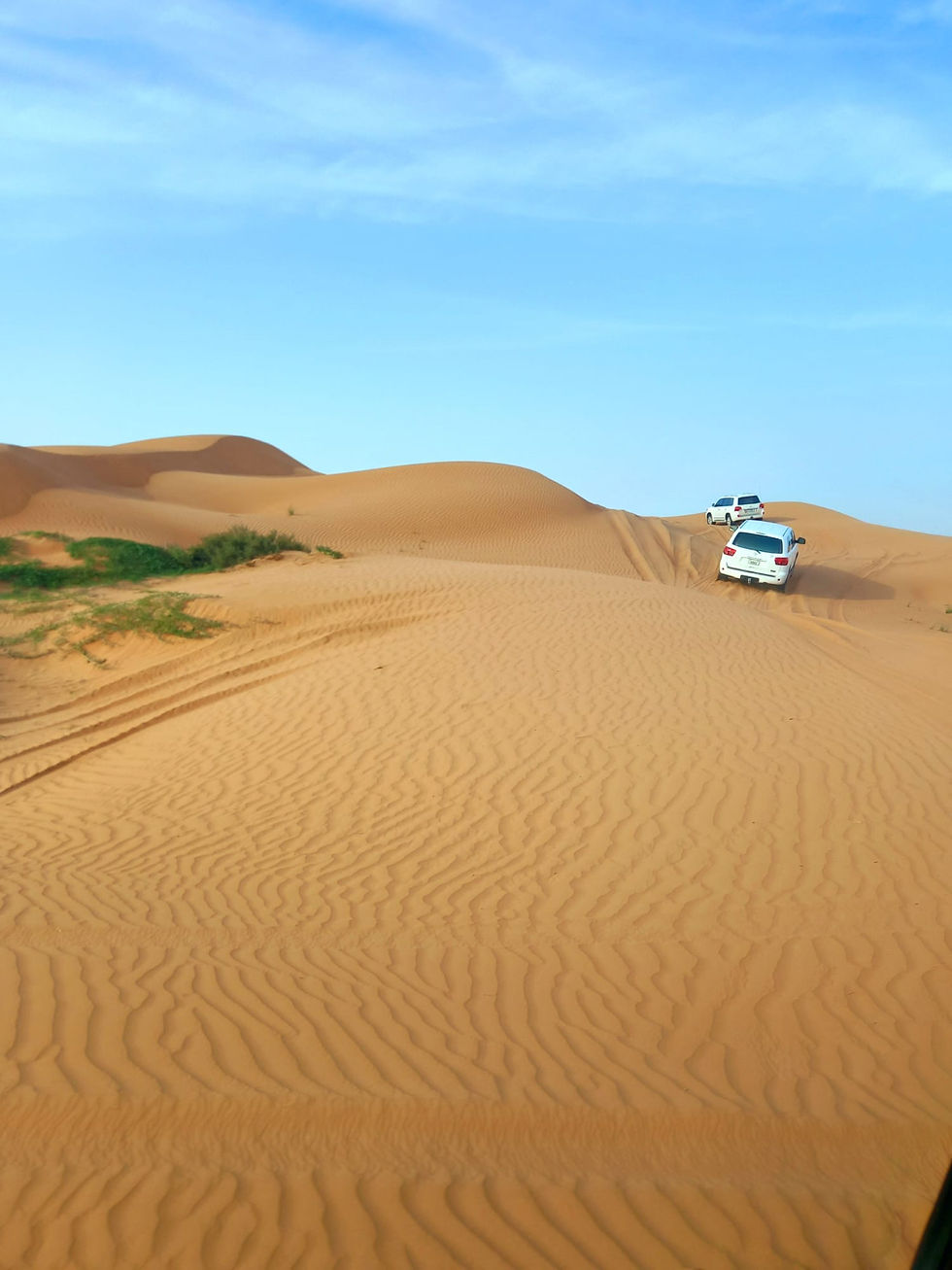
Everything I've described so far relates to a full, lengthy safari — one that includes dinner and performances.
For those who don't want dinner or the entertainment part, a shortened version is available — it covers the entire desert stage, i.e. dune bashing, sandboarding, photographs, as well as the option to add quads, but without the camp element.
It also offers greater flexibility with timing, as it doesn't depend on the dining and performance schedule.
It's a great option for people visiting during the hot season who still want to experience a desert safari.
Who is a desert safari suitable for?
A desert safari is an attraction suitable for most tourists, and I very often see families with children who have a wonderful time during such an evening.
Typically, children can participate from the age of three (sometimes child seats for small children are also available), however it's worth knowing that the dune bashing can be very intense.
For this reason, I usually don't recommend this activity for pregnant women, people who are very sensitive to car travel, or very elderly people. That doesn't mean you can't go on a safari at all. You can simply wait at the camp or at a designated spot during the dune bashing. You can also choose the private option.
The safari we work with
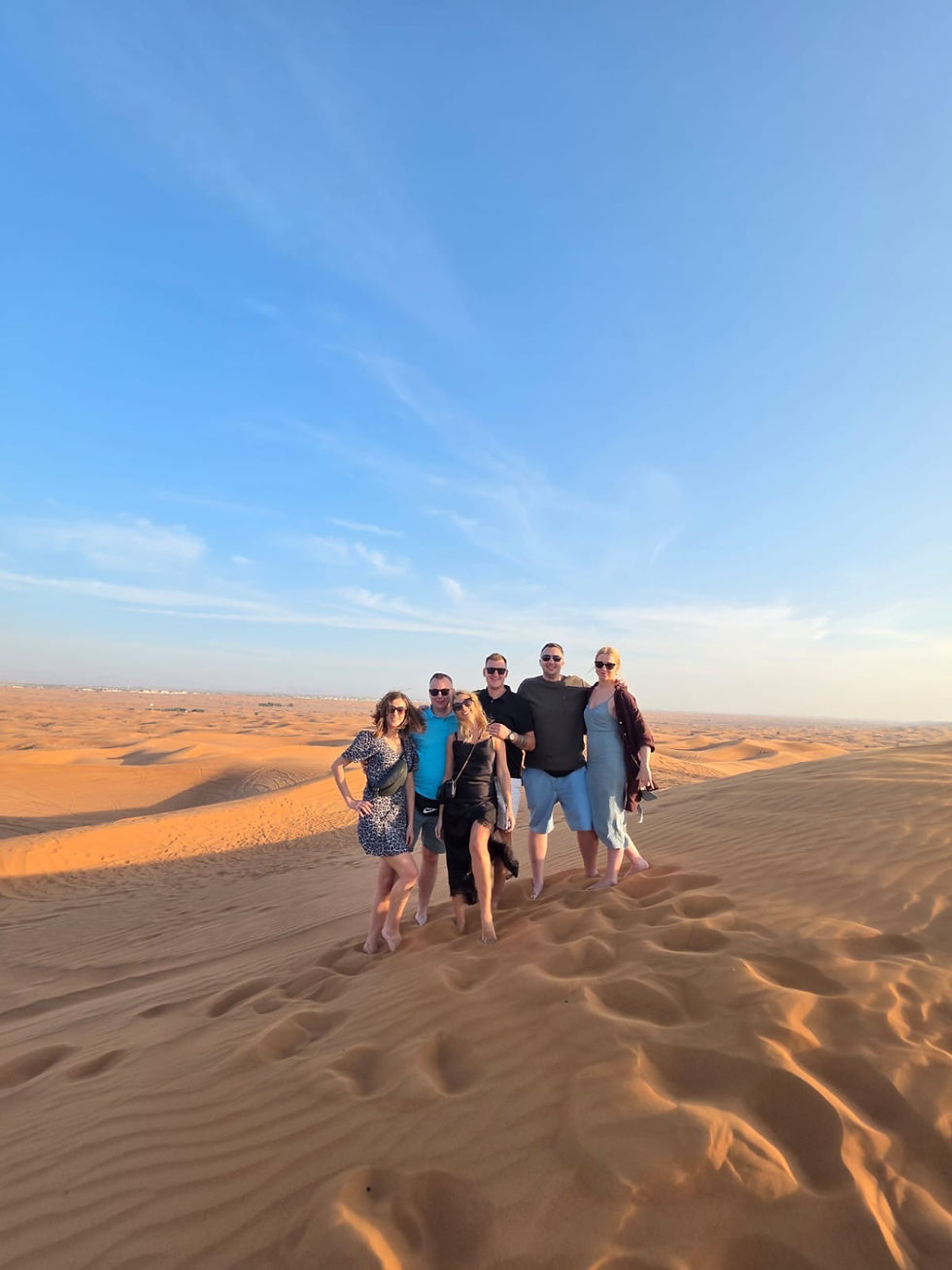
After visiting several different camps and checking many options, we chose to work with a few camps in three emirates: Dubai, Abu Dhabi and Ras Al Khaimah.
All the camps we work with are at a premium level or above, with a particular emphasis on safety, food quality and a pleasant experience for guests.
If you'd like to see the different options, do visit our safari page.
Summary — 5 rules for choosing a safari wisely
Don't just look at the entry price — check what exactly that price covers.
Ask about group size — how many people in the vehicle? How many at the camp? The fewer, the better.
Check whether hotel pick-up is included — a taxi ride to a meeting point in the desert costs an extra 50–100 AED.
Read reviews — but CAREFULLY. Look for reviews mentioning hidden costs and quality.
Book before you fly — a good safari has limited places (because groups are small). If you book on the spot, you'll be left with whatever's available.
REMEMBER — Buggies and quads always cost extra. The price on site will be higher than when booking in advance.
Tip for perfect desert photographs
White dress in the desert Sunset in the desert Desert sand throwing Sunset in the desert All in white


rr88k1.com hôm bữa mình cũng tò mò vào thử vì thấy mọi người nhắc, chủ yếu xem giao diện ra sao thôi chứ không đọc kỹ nội dung. Cảm giác đầu tiên là trang nhìn khá sạch và thoáng, không bị dồn chữ nên lướt nhanh vẫn nắm được mình đang ở mục nào. Mình thích nhất là cách họ chia thông tin theo từng khối rõ ràng, kéo xuống là thấy phần nào ra phần đó nên mắt đỡ mỏi. Thanh menu cũng để ngay chỗ dễ thấy, bấm qua lại vài mục mà không phải mò mẫm. Nói chung kiểu sắp xếp này hợp với người mới vào xem thử, nhất là mấy bảng dạng cột nhìn gọn…
I had an excellent experience with their fertility clinic with experienced consultants in London. From the moment I walked into the clinic, I felt welcomed and reassured by the friendly staff. The consultant took the time to understand my concerns, thoroughly reviewed my medical history, and recommended a personalised treatment plan. Every appointment was professional, informative, and never rushed. The level of care and attention I received exceeded my expectations, and I would confidently recommend this clinic to anyone seeking fertility support. www.lunafertility.co.uk
Great insights on how to choose the right desert safari in Dubai, especially the tips about comparing experiences and tour options. The guidance is helpful for travelers who want to enjoy the desert safely and comfortably. Planning the trip is also easier when visitors can Dubai Visa Apply Online before their journey. Overall, this is a useful guide for anyone preparing for a memorable Dubai desert adventure.