

A Brief Guide to Clothing in the UAE
Updated: Apr 8
If this is your first visit to the United Arab Emirates, you're probably wondering while packing your suitcase what clothes will be appropriate and what won't. Arriving at the airport won't clear up your doubts, because you'll see all kinds of exotic outfits from every corner of the world. Some may look familiar, but most probably won't! Standing in the passport control line, you'll be surrounded by numerous security staff dressed in traditional white and black robes.
At first this can be quite intimidating, but you'll quickly realize that the UAE is a thriving international hub, and what you're seeing is simply the traditional dress of local residents alongside other diverse international communities. The UAE is a true cultural melting pot, in the best possible sense of the word.
So, step by step, here's a Brief Guide to Clothing — the names and what traditional clothing in the United Arab Emirates looks like:
Men
Kandura / Dishdasha

A long, loose robe worn by men in the UAE, usually white. It is lightweight, breathable and well suited to the hot climate. In the Emirates, the kandura typically has a simple, elegant cut and is the foundation of traditional men's dress. It is made from cotton or wool, designed to protect against the heat. The kandura, especially in winter, also comes in various colors — browns, navy blue, burgundy...
Tarboosh

The small cord on the kandura — a distinctive braided tassel at the neckline of the Emirati kandura. It's a decorative element, but it also has a traditional function: it is often perfumed, dipped in oud, musk or other Arabian fragrances, so that the wearer smells pleasant for a long time. Sources describe it as a scented tassel or "diffuser" tied to Emirati tradition.
Ghutra
A traditional headscarf worn by men in Gulf countries. In the UAE it is most commonly white and is placed over a gahfiya, with an agal — a black cord/ring — secured on top. Its purpose is both practical and cultural: it protects the head from the sun, dust and wind, while also being an important element of traditional Emirati dress.
Agal and gahfiya

Agal – a black, double cord worn on the head, placed over the ghutra. Its main purpose is to hold the ghutra in place, preventing it from slipping or shifting. It is an important element of traditional men's dress in the Gulf countries.

Gahfiya – a small, fitted cap worn under the ghutra. It helps keep the ghutra and agal stable on the head, improves wearing comfort and prevents the fabric from sliding. It is usually white and delicately embroidered or openwork.
Together, these two elements help to properly arrange and wear the ghutra.
Traditional Sandals

Simple, elegant sandals, usually made of leather, worn with the kandura. They typically come in brown, beige, black or tan. They have a flat sole or very low heel and are adapted to the hot climate — breathable, comfortable and easy to slip on quickly.
Women
Abaya
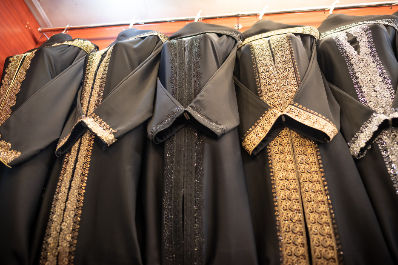
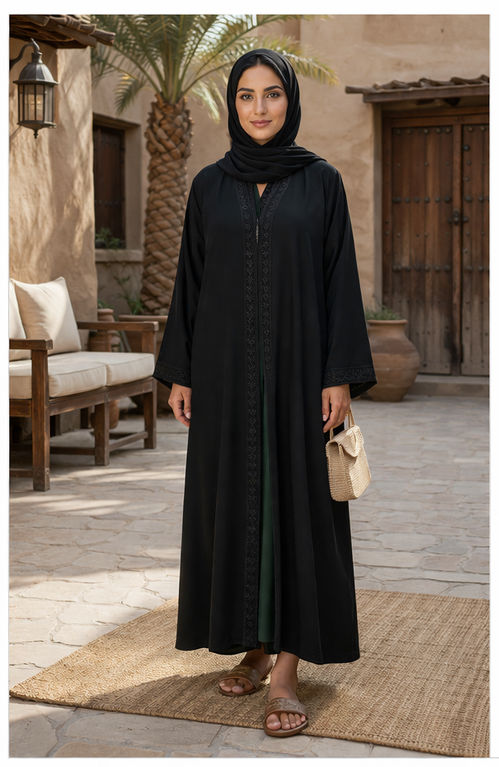
A long, loose outer garment, most commonly black, though women often wear them in various colors. It is usually richly embroidered. It is worn over regular clothing. This is the most recognizable element of contemporary women's dress in the Emirates. It covers the entire body except for the face, hands and feet. Sources on Emirati dress indicate that the modern abaya gradually replaced older forms of head covering and outer garments in everyday use.
Hijab / Shayla

A long headscarf. It covers the hair and neck and is paired with the abaya. Women wear them in various colors, most often matching the color of their abaya. In traditional descriptions of wedding and women's dress in the UAE, the shayla appears as a separate element of attire alongside the burqa and abaya.
Niqab

A fabric face veil that covers the face and leaves the eyes exposed. It is worn together with a headscarf and abaya. It is primarily associated with religious modesty and privacy, rather than specifically with traditional Emirati folk dress. In practice, it can be seen in the UAE, but it is not the same as the traditional Emirati mask. It is more of a broader garment found in various parts of the Arab and Muslim world.
Burqa’a / Batoola
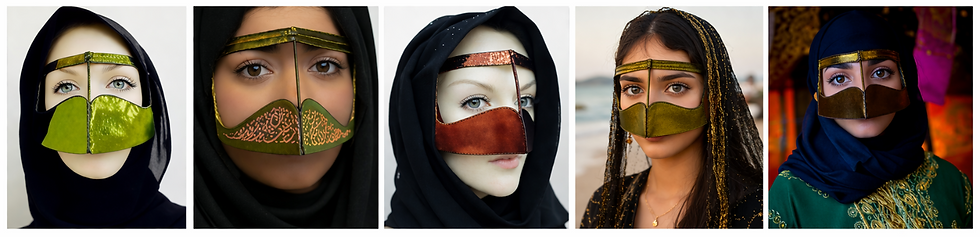
This is the distinctive mask. It usually has a golden, navy blue, purple or dark metallic sheen. In the past it was larger and covered more of the face; today it appears more often at traditional occasions, among older women or during cultural events. Historically it was associated with modesty, and in the Emirates it was traditionally worn by married women.
Henna, Jewellery, Perfumes, Oud, Makhmaria

With women's dress, accessories and preparation are also very important: henna decorating the
hands and feet, incense, oud, and perfumes for hair and clothing. Traditional Emirati women's jewelry is lavish, most often gold, worn especially on important occasions. It typically includes large necklaces, earrings, bracelets, rings, head ornaments and sometimes nose or forehead decorations. It served not only a decorative function but also highlighted status, wealth and the importance of the occasion.

During holidays and ceremonies in the Emirates, these are permanent elements of a woman's appearance.
It is important not to confuse religion with culture. The official guidelines of Islam require modesty from women, however the way it is achieved depends on cultural customs and personal preferences. In today's UAE, the niqab is still visible but less common. Among younger generations of local men and women, there is also a growing trend of wearing non-traditional, Western styles of clothing in certain situations.


Comments